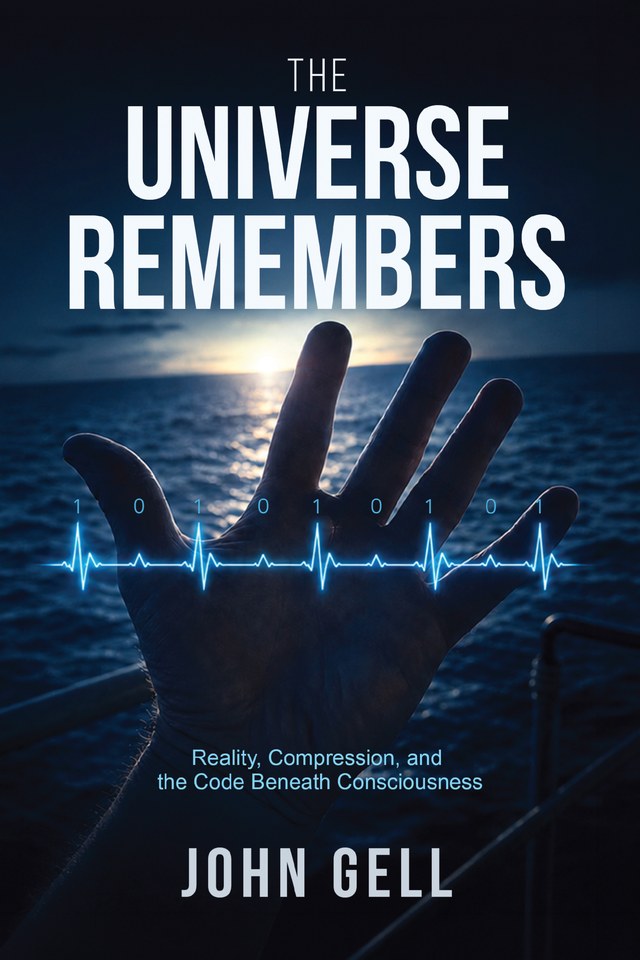
Out Now
Read it now
Available on Kindle and in paperback — published by Lossless Press.
Buy on Kindle
Paperback — coming soon
ISBN 978-1-0667566-0-5 · Lossless Press
Reality, Compression, and the Code Beneath Consciousness
What if the most important number in physics has just been badly formatted?
Out Now
Available on Kindle and in paperback — published by Lossless Press.
ISBN 978-1-0667566-0-5 · Lossless Press
The Idea
The speed of light, written the way we happen to write it, looks like a credit-card number: 299,792,458. Measure it instead in units a human body actually owns — the width of a hand, the beat of a heart — and write it in base twelve, the base our clocks and our dozens never abandoned, and it falls into a pattern you can hold in your head:
1 0 1 0 1 0 1 0 1. An alternating wave.
From there the book follows a single idea: that reality works the way every system an engineer has ever repaired works — by compression. Keep the rule, throw away the instance, rebuild on demand. It is how a DVD holds a film, how DNA holds a body, how a single night's sleep holds a day. What if it is also how the universe holds itself?
The Universe Remembers follows that one idea out through sleep, memory, grief, instinct, music, language, and the strange arithmetic that keeps surfacing across ancient cultures — one domain per chapter.
An Honest Compass
It is not a proof of a new physics, and it never pretends to be. It is something rarer: a working engineer's lens on the oldest questions, offered in the spirit of here is a strange and beautiful way to see — now check it yourself.
So every claim is openly graded. You always know which footing you are standing on:
Before We Begin
This is a book about a number. But really it is a book about you.
The number is the speed of light. Not in the units you learned in school — 299,792,458 metres per second, an unremarkable string of digits. In a different set of units, units anchored to the human hand and the human heartbeat, the speed of light is this:
1 0 1 0 1 0 1 0 1Nine digits. Alternating ones and zeros. The universe's ultimate speed limit, expressed in the most natural units available, is an alternating binary wave.
I am not a physicist or a mathematician. I am an engineer — a hands-on technician who works offshore with subsea robotics… I tell you this so you know exactly whose hand you are holding as we walk through this.
I do not know that the universe is a fractal. I only know the question would not let me sleep.
For Those Who Want the Workings
The rigorous, labelled sibling: the mathematics, the unit system, the uniqueness test, the controls. Shorter and harder than this book. Where this book is the meaning, that one is the workings. You don't need it to read The Universe Remembers — but it's there when you want the equations behind a claim.
And it's free. Subscribe and I'll send you the complete Science Edition — PDF and ePub — at no charge.
Free Download
Enter your email and I'll send you the complete Binary Universe — Science Edition (PDF + ePub) — the rigorous companion, free. You'll also get the occasional note from behind the cable. No spam, unsubscribe anytime.